What Your Legacy Platform is Actually Costing You (And Why 14 Weeks Fixes It)

Abitha Jeyaraj, Marketing Executive
November 3, 2026 · 4 min read

Your legacy system works.
It’s been running for 12-15 years. Users know how to work around it. Your support team has muscle memory for every edge case. So why does your CFO want to replace it?
Because the system that works is secretly costing you.
The Three Costs Nobody Talks About
Cost 1: Supply Chain Visibility Lag
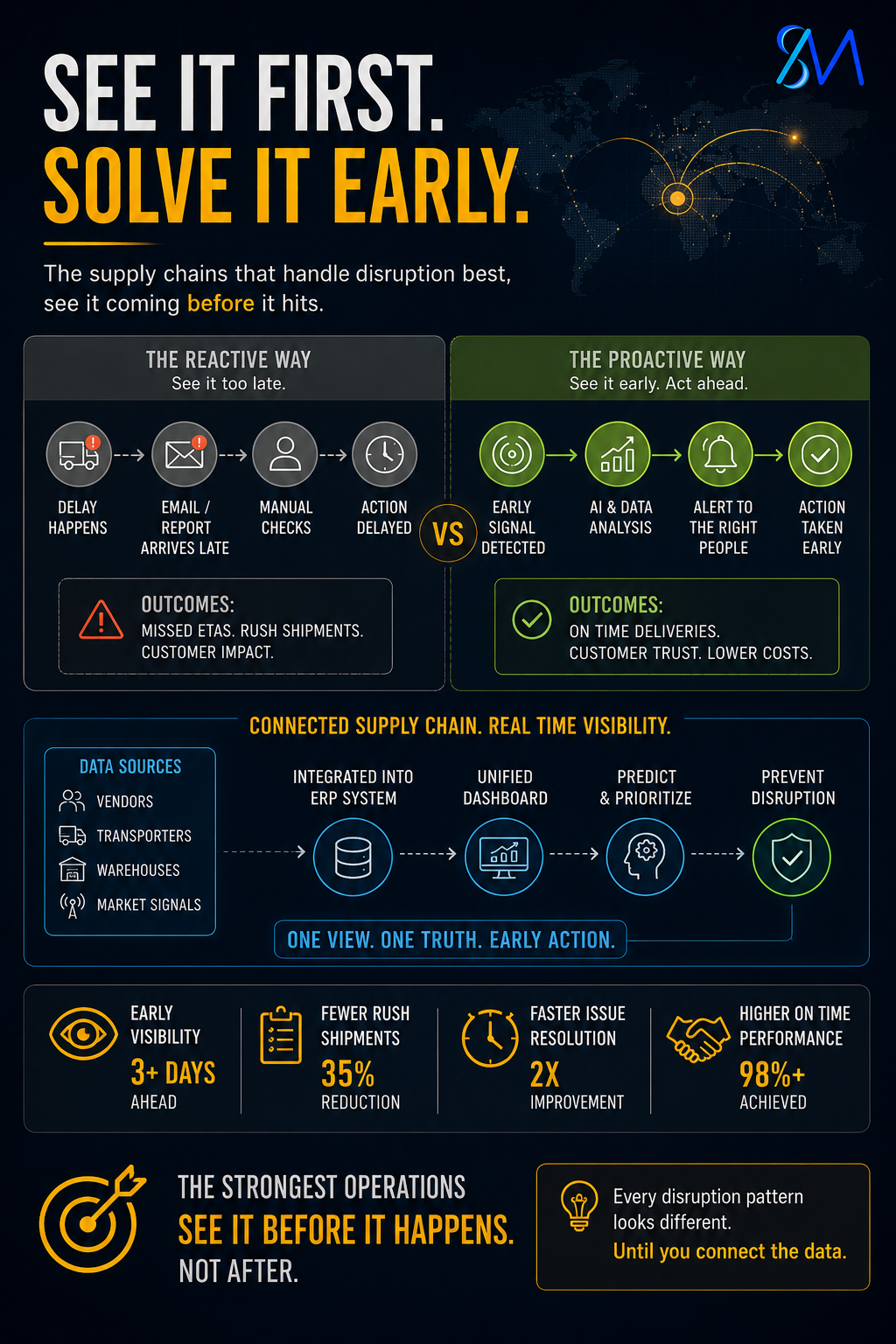
Your inventory platform updates every 4 hours. Your supply chain partners need real-time visibility.
What this means:
- Procurement team makes decisions on 4-hour-old data
- Supply disruption isn’t caught until hours later
- Expedited shipping kicks in (emergency cost)
- Just-in-time suppliers can’t commit (you become unreliable)
Real math:
- Average manufacturing company: 18-22% of shipments expedited
- Expedited cost premium: $15-25K per shipment
- Monthly expedited shipments: 50-100
- Annual cost: $900K-$2.1M in unnecessary expedite fees
One manufacturing client (automotive supplier, $300M revenue) measured this:
| Metric | Before | After |
|---|---|---|
| Visibility delay | 4 hours | 8 seconds |
| Expedited shipments/year | 850 | 695 |
| Annual expedite cost | $2.1M | $1.4M |
| Cost savings | — | $700K |
| Payback period | — | 7 months |
Cost 2: Manual Workaround Hours
Your legacy system is slow. Your team built workarounds.
- Someone reconciles inventory manually once/week (4 hours)
- Someone runs custom board reports manually (6 hours)
- Someone retries failed transactions manually (3 hours/day)
- Someone verifies data integrity in spreadsheets (2 hours/week)
That’s 40+ hours/week of manual work.
- Cost per hour (all-in): $75
- Weekly cost: $3,000
- Annual cost: $156,000
That’s a headcount. A person who could be doing something strategic, instead doing manual data hygiene.
Cost 3: You Can’t Scale
Your legacy system has limits. You hit them.
- You can’t add a new supply chain partner (requires code change)
- You can’t increase transaction volume (performance degrades)
- You can’t add new features (vendor is out of business; nobody maintains it)
So you stay stuck.
- You want to expand to a new region. You can’t, because the system can’t handle it
- You want to add a new product line. You can’t, because you can’t track it
- You want to improve margins. You can’t, because you can’t see the data you need
Opportunity cost: $5M-$15M in revenue you can’t pursue.
The organisations getting sustained value all start with the same question: What is our legacy system actually costing us?
That answer, calculated clearly, becomes your business case for change.
The Math
Annual Cost of Staying:
| Item | Cost |
|---|---|
| Expedited shipping overages | $2.1M |
| Manual workaround labor | $156K |
| Lost scaling opportunities | $5M-$15M (opportunity cost) |
| TOTAL | $7.3M-$17.3M |
Cost of Fixing It:
| Item | Cost |
|---|---|
| 14-week platform migration | $1.45M |
| Stabilization + training | Included |
| TOTAL | $1.45M |
Payback period: 7 months on expedite savings alone.
Why Most Companies Stay Stuck
Three reasons:
1. The cost is distributed
Expedited shipping is a line item nobody ties to “legacy system.”
Manual labor is spread across 5 people, none of them labeled “legacy system waste.”
Opportunity cost is invisible (you never see the revenue you didn’t get).
So the CFO doesn’t see the $7.3M number. They see a $2.5M migration cost and say “nope.”
2. Migration risk feels real
“What if the new system breaks?” “What if we lose data?” “What if customers can’t order for a week?”
Real concerns. But they’re addressable with the right architecture partner.
3. The vendor story is “maintenance mode”
Your current vendor says: “System is stable. No urgent need to migrate.”
They’re right. The system IS stable.
But stable ≠ good. Stable ≠ cost-effective. Stable ≠ scalable.
How a 14-Week Migration Actually Works
Most vendors pitch “code deployment” as the goal. We pitch “business transformation” as the goal.
Phase 1: Architecture (Weeks 1-10)
- Measure your actual legacy system costs (supply chain visibility, manual work, constraints)
- Design new system to eliminate those costs
- Real integration testing (not benchmarks — your actual production patterns)
- Locked timeline, locked cost
Phase 2: Stabilization (Weeks 11-14)
- Go-live at your planned time
- We’re on call 24/7
- We’re tuning performance against YOUR production data (not test benchmarks)
- Your team is trained, confident, independent by week 14
Phase 3: You Own It
- Platform is stable, costs are locked, your team knows how to operate it
- Decision: hand off completely, or move to managed services
The Guarantee
COST OF STAYING vs. FIXING
Stay (3-year cost):
$7.3M-$17.3M/year × 3 years = $21.9M-$51.9M
Fix (3-year cost):
$1.45M (migration) + manage platform = $2.5M-$3.5M
NET SAVINGS:
$18.4M-$49.4M over 3 years
Your payback: 7 months (expedite savings alone)
What Happens Next
You probably know:
- Your inventory visibility delay
- Your expedite shipping costs
- Your manual workaround overhead
But you’ve never tied them together.
Let’s do that in a 30-minute assessment. We’ll map your specific legacy system costs against the 14-week fix. Then you can show your CFO the actual ROI number (not our benchmark).
That’s how you get board approval.
Calculate your specific legacy system cost.
We’ll map the ROI and show your board the 14-week fix.